
Living benefits life insurance South Carolina allows policyholders to access a portion of their death benefit while still alive to pay for expenses related to chronic, critical, or terminal illnesses. Most residents do not have this protection because they are unaware of modern policy riders or they still hold older plans that only provide a payout upon death. "Living Benefits" life insurance is a financial tool everyone should own.
Most South Carolina families buy life insurance thinking about one thing: what happens after they're gone. But what happens if you survive a heart attack, get diagnosed with cancer, or suffer a stroke that leaves you unable to work for months or years? Your standard life insurance policy won't help you pay a single bill.
That gap in coverage is exactly where living benefits come in, and it's a protection most families in Upstate South Carolina don't even know they're missing. In this post, you'll learn what living benefits actually are, which critical illness and chronic condition riders matter most, how they compare to standard term coverage, and how to get a policy that works for you while you're still alive to need it.
The Short Answer: Life Insurance You Don't Have to Die to Use
Here is the short answer: certain life insurance policies let you access a portion of your own death benefit while you are still alive. If you are diagnosed with a terminal, critical, or chronic illness, you do not have to wait until death for the policy to pay. That is what we mean when we say "Life Insurance You Don't Have to Die to Use".
These features, broadly called living benefits, are built directly into the policy structure or added as riders. They exist because a serious illness can financially devastate a family long before it becomes fatal. Medical bills, missed paychecks, and ongoing care costs do not wait.
The catch is that most standard policies sold across South Carolina do not include these features by default. Many families in Pickens County and throughout the Upstate are carrying coverage that only pays at death, leaving a significant gap in protection that most people don't realize is there until they actually need it.
What Living Benefits Actually Cover: The Three Core Riders

So what exactly do these riders cover? Living benefits policies are built around three core riders, and each one responds to a different kind of health crisis.
Terminal Illness Rider
This rider activates when a physician certifies that the insured has a life expectancy of 12 to 24 months or less. It allows the policyholder to access a portion of the death benefit early, while there is still time to use it. Think about what that actually means: paying off a mortgage, funding final medical care, or simply having the financial breathing room to stop working and spend time with family. Most carriers include this rider at no additional premium, which makes it one of the most accessible living benefit features available.
Critical Illness Rider
This rider covers qualifying events such as heart attack, stroke, cancer diagnosis, kidney failure, and major organ transplant and more. Consider the numbers: South Carolina consistently ranks above the national average for cardiovascular disease and cancer mortality, which means this is not a theoretical risk for Upstate SC families.
If you are 54 years old in Pickens County, you have a family depending on your income, and you suffer a heart attack, your health insurance may cover the hospital bills. But it will not replace the two or three months of paychecks you lose during recovery. A critical illness rider on a $250,000 policy could allow you to access $75,000 right then to cover both.
Chronic Illness Rider
This rider triggers when the insured can no longer perform at least two Activities of Daily Living, things like bathing, dressing, or eating independently, or when severe cognitive impairment is present. This is not the same as long-term care insurance, which is a standalone policy with its own underwriting and benefit structure.
The chronic illness rider works within your existing life policy as a financial bridge, providing access to your death benefit before you need skilled nursing care, before Medicare may apply, and before your savings are depleted.
Each rider addresses a distinct financial threat. Together, they form a protection layer that a standard death-only policy simply cannot provide.
Why Most South Carolina Families Are Missing This Protection

Understanding what these riders cover is one thing. Understanding why most South Carolina families do not actually have them is another.
The most common reason is how the policy was originally purchased. A large portion of Upstate SC residents have life insurance through an employer group plan or were sold a policy by a captive agent representing a single carrier. Employer group life is almost never designed with living benefit riders attached.
And a captive agent, whatever their intentions, can only offer what their one company has on the shelf. If that carrier does not include robust living benefit options, the client simply does not get them.
The second issue is timing. Policies sold 15 or 20 years ago were built under different product designs. Living benefit riders, particularly chronic illness riders, became more widely available as the industry evolved. A family in Easley who bought a solid term policy in 2004 may have done everything right at the time and still be sitting on coverage that has no provision for a serious illness today.
Third, and most practically: most people do not know to ask. Living benefits are not a standard part of most insurance conversations. If no one mentions them, most buyers assume their policy covers what it needs to cover.
This is exactly where working with an independent agencies like the Shanley Insurance Agency can change the outcome. Independent agents represent multiple carriers and can identify which companies include terminal illness acceleration at no added cost, which ones offer the strongest chronic illness definitions, and which riders are actually worth the additional premium.
Shanley Insurance Agency has been helping families navigate living benefits life insurance in Upstate SC since 1999, with a specific focus on policies built around these protections. That matters in communities like Pickens County and Easley, where most households depend on a working income. A stroke, a cancer diagnosis, or a chronic condition that sidelines someone for six months does not just create medical bills. It removes the paycheck the household runs on.
Standalone disability income protection and long-term care policies can fill some of those gaps, but both become harder to qualify for as you age or if your health changes. A life policy with living benefit riders, secured while you are still healthy, is often the most accessible safety net available.
Living Benefits vs Standard Term Life: What's the Real Difference
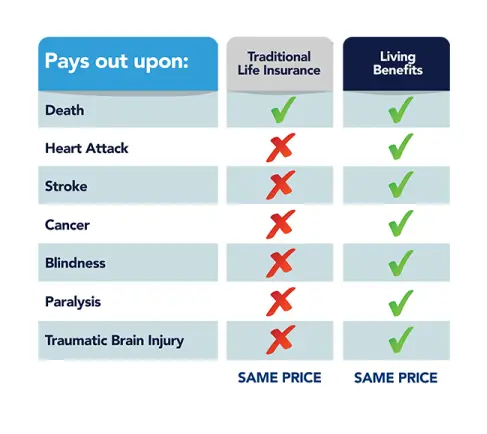
So what is actually different between a standard term policy and one with living benefits? The simplest way to put it: a standard term policy has one job. It pays your beneficiaries when you die. A policy with living benefits has that same job, plus the ability to pay you during a qualifying illness before death ever enters the picture.
That distinction matters more than most people realize when they are sitting down to choose coverage.
A few things worth understanding before you compare policies side by side:
Not all living benefit riders reduce the death benefit dollar for dollar. Depending on the carrier and the rider type, an acceleration may be calculated differently, meaning your beneficiaries could still receive a meaningful payout even after you accessed funds during an illness.
Terminal illness acceleration is often included at no added premium. Critical illness and chronic illness riders typically carry a modest additional cost, but for most working-age adults in Pickens County or Easley, that cost is considerably smaller than the gap it fills.
As for the question people ask most directly: is living benefits life insurance South Carolina families can access actually worth the added cost? For most households where one income funds the mortgage, the grocery bill, and everything else, yes.
Health insurance will handle the hospital. It will not write a check for the four months of paychecks lost while recovering from a stroke or completing cancer treatment. That income gap is where a living benefits policy does work that nothing else in a standard coverage plan covers.
How to Get a Life Insurance Policy With Living Benefits in Upstate SC

Knowing the value of living benefits is one thing. Actually getting a policy structured the right way requires a few deliberate steps.
Start with an independent agent. This is the most important step. Not every carrier offers robust living benefit riders, and a captive agent representing a single company can only show you what that company sells. An independent agent like the Shanley Insurance Agency compares options across multiple carriers and can tell you which ones include terminal illness acceleration at no extra cost, which chronic illness definitions are broader, and where the real value sits for your age and health profile.
Pull out any policies you already have. Many Upstate SC residents are surprised to find they already have an accelerated death benefit provision in a policy they bought years ago. Before purchasing anything new, review what you are currently carrying. You may have more protection than you realize, or you may confirm the gap.
Understand the definitions before you sign. The terms "critical illness" and "chronic illness" are not standardized across the industry. One carrier's definition of chronic illness may require permanent impairment; another may apply to a temporary but severe condition. The fine print matters here.
Act while your health is on your side. Living benefit riders go through underwriting. A 42-year-old in good health will qualify more easily and at lower cost than someone applying at 58 with a prior diagnosis.
Shanley Insurance Agency offers free phone or in-home consultations throughout Pickens, Easley, and the broader Upstate, and has worked with top-rated carriers offering living benefits life insurance in Upstate SC since 1999. The goal is always to find coverage that actually fits how your household runs.
Frequently Asked Questions About Living Benefits Life Insurance in South Carolina
A few questions come up consistently when South Carolina families start looking seriously at living benefits life insurance. Here are direct answers.
Does life insurance cover conditions like Parkinson's disease? It depends on the rider and the carrier. Some chronic illness riders will cover Parkinson's disease if the condition progresses to the point where the insured cannot perform at least two Activities of Daily Living. Because coverage definitions are not standardized across the industry, the specific language in your policy determines whether a given diagnosis qualifies.
Do living benefits cost extra? Terminal illness acceleration is typically included at no additional premium on most policies available today. Critical illness and chronic illness riders generally add a modest cost that varies by your age and health at the time of application. For most working-age adults in Pickens County and the Upstate, that added premium is modest relative to the income gap those riders are designed to fill.
Can I add living benefits to my existing policy? Sometimes, but the answer depends on your carrier and your current health. Many older policies were simply not designed to accept these riders after issue. In most cases, purchasing a new policy with living benefits life insurance in Upstate SC built in from the start is the more practical path.
Are living benefit payouts taxable? Generally no. Under IRS guidelines, accelerated death benefit payments are typically excluded from gross income when the insured is certified as terminally ill. Chronic illness rider payouts can carry different tax treatment depending on how the benefit is structured. A tax professional can clarify how a specific payout would apply to your situation.
Understanding how living benefits can protect your financial future is the first step toward true peace of mind. These features ensure your policy works for you during your lifetime, providing essential support when you need it most.
If you want expert help navigating these options, our team at the Shanley Insurance Agency is here to guide you. You can learn more about how Living Benefits fit into your coverage by speaking with a local agent today. We are ready to help you find the right balance for your family's needs.